
Hot shot trucking is among the fast-growing niches in trucking that involves an alternative to transporting smaller, time-sensitive loads with pickup trucks and trailers instead of regular 18-wheelers.
In essence, it involves transporting time-sensitive freight using medium-duty trucks (typically class 3-5 pickups) and flatbed trailers, typically for a single customer per trip. This sector plays an important role in logistics by delivering critical parts and equipment quickly to keep projects on track.
If you’re a new or less-experienced driver considering a hot shot trucking career, this guide is for you. We’ll cover everything from basic definitions and requirements to lifestyle, financials, safety, and real-world advice. By the end, you’ll have a solid understanding of what hot shot trucking entails and how to get started on the right foot.
What Is a Hot Shot Trucking by Definition?
Hot shot trucking refers to the act of hauling relatively small but urgent loads using a pickup truck (most often a 3/4-ton or 1-ton truck) with a trailer. Unlike the standard long-haul trucking that uses big Class 8 semi trucks for full trailer-load hauls, hot shot drivers typically haul less-than-truckload (LTL) freight or individual loads that have to be delivered quickly.
Common hot shot loads are building materials, agricultural or industrial equipment, equipment components, or anything that must be transported in a hurry to prevent downtime (like a backup pump for an oil operation or a critical component for a factory). Hot shot drivers generally operate as independent owner-operators or small business owners, so they are able to set their own schedule and determine which loads to take.
Historical Background and Development
Hot shot trucking originated in the Texas oil fields of the 1970s. At that time, there were several instances where the oil companies needed parts in a hurry.
It is said that drivers used to stop alongside manufacturing factories and wait until the drill part was ready, then load the part in their pickup and leave to the oil well to avoid the shutdowns. It was this “on-call” provision of critical equipment that bred the hot shot concept. Soon, what started in oil and gas had branched into other sectors like construction, agriculture, manufacturing, and disaster response. Today, it is a widespread practice across the entire nation of hot shot trucking. It is facilitated by technology (like load boards and GPS routing), even to owner-operator drivers, to obtain direct access to immediate loads and haul across state lines short notice.
The idea is the same: provide quick, flexible carriage for time-sensitive cargo that doesn’t require a full-size semi-truck.
How Hot-Shot Trucking Differ from Conventional Trucking?
Hot shot trucking and traditional long-haul trucking both serve the freight industry, but they operate in very different ways. From vehicle size to business structure, the contrasts between these two styles of trucking can significantly affect your daily routine, responsibilities, and opportunities.
| Aspect | Hot Shot Trucking | Long-Haul Trucking |
|---|---|---|
| Vehicle Type | Uses pickup trucks (typically Class 3–5) with flatbed or gooseneck trailers | Uses Class 8 semi-trucks with 53’ dry vans, reefers, or flatbeds |
| Cargo Capacity | Smaller payloads; suited for LTL (less-than-truckload) or single urgent shipments | Larger volume loads; often FTL (full truckload) |
| Type of Loads | Emergency, time-sensitive, or specialty freight; sometimes one-off deliveries | Scheduled, repeat lanes with mixed or bulk freight |
| Delivery Speed | Often expedited: same-day or overnight delivery | Can range from multi-day to week-long deliveries |
| Routes and Lanes | No fixed lanes; routes change based on available or urgent loads | Often consistent, planned lanes with recurring schedules |
| Business Structure | Primarily owner-operators who run their own business | Many are company drivers or lease operators under a larger carrier |
| Flexibility | High; choose when and where to run loads | Lower flexibility unless operating under own authority |
| Operating Costs | Lower upfront and operating costs; smaller equipment | Higher costs for fuel, maintenance, and equipment |
| Regulatory Compliance | Must comply with nearly all FMCSA regulations, just like semi-truck drivers | Full compliance required under FMCSA and DOT standards |
| Stability of Work | Work volume can fluctuate; more dependent on market volatility | More predictable workload if employed by a large carrier |
What are the Requirements and Qualifications for Hot Shot Trucking?
One of the advantages of hot shot trucking is that you don’t have to worry about a Commercial Driver’s License (CDL) as long as you keep your vehicle’s gross weight below thresholds.
For combination vehicles (truck + trailer) with a Gross Combination Weight Rating (GCWR) of 26,001 lbs or more in the United States, a CDL is usually necessary. Most hot shot combinations deliberately stay under this 26k weight limit (such as a 1-ton truck rated ~14,000 lbs towing a trailer rated ~12,000 lbs) so you don’t require a CDL. But without a CDL, even if you drive as a for-hire carrier across state lines, you are still governed by significant Federal Motor Carrier Safety Regulations.
This means registering for a USDOT number and likely an MC (Motor Carrier) operating authority (required for interstate commerce). You’ll also need to pass a DOT medical exam and carry a valid medical certificate, since hot shot drivers must meet medical qualifications just like big rig drivers. Interestingly enough, there are still age limits: to drive commercially on state lines, you must be 21 (18-20 year olds are typically restricted to intrastate only).
Briefly, while a CDL might not be necessary for lighter hot shot operations, most drivers do get a Class A CDL anyway – it expands your load possibilities and prepares you in case you’re going to carry more in the future.
Types of Vehicles and Equipment
Hot shot trucking does not use the standard semi truck and 53′ trailer. Instead, it uses smaller, more maneuverable equipment. The truck is usually a heavy-duty pickup – usually a 3/4-ton or 1-ton pickup like a Ford F-350, Chevrolet Silverado 3500HD, Nissan Titan XD, or similar. These trucks are powerful enough to pull heavy loads but small enough to be used for personal purposes. Some hotshotters even use cab-and-chassis medium-duty trucks (Class 5) with a flatbed mounted on them.
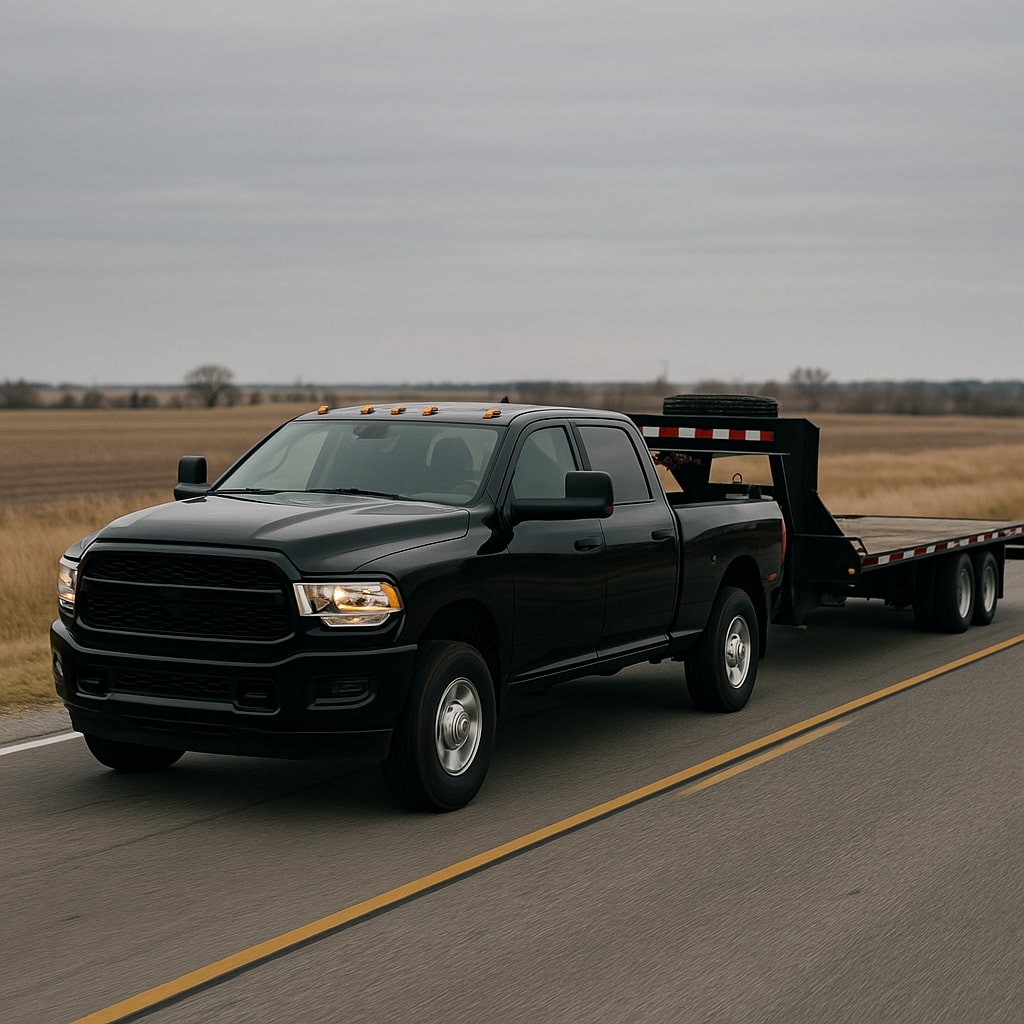
The trailer itself is most often a flatbed model, such as a gooseneck trailer of 20 to 40 feet in length. Typical configurations are 30′ flatbeds or 40′ gooseneck trailers (with optional ramp). The actual configuration depends on the niche freight: automobiles and boats are pulled on a car-hauler type trailer, while building materials may ride on a common flatbed. Non-CDL hotshot setups often use slightly smaller trailers to stay under weight limits (e.g. a 25 ft trailer behind a single-wheel 1-ton truck), whereas CDL hotshots might use dually pickups with 40 ft goosenecks for maximum capacity.
Aside from the truck and trailer, you’ll need essential equipment like ratchet straps, chains and binders, tarps, and edge protectors to secure and protect loads. Many drivers install extra toolboxes and auxiliary fuel tanks on their pickups for long runs. It’s also required by law to carry safety gear (fire extinguisher, reflective triangles, spare fuses, etc.) in your vehicle.
In essence, the equipment for hot shot trucking is a scaled-down version of what big rigs use – but you’ll still be hauling serious weight, so robust trucks and trailers are a must.
Insurance and Paperwork
Don’t let the smaller truck fool you; you are a commercial carrier as a hot shot trucker and need proper insurance coverage and compliance paper work. Commercial liability coverage is required with a minimum of $750,000 coverage for interstate for-hire trucking (federally required).
In practice, most shippers and brokers will require $1,000,000 liability coverage, plus cargo insurance (most often $100k cargo coverage is normal). You will also require physical damage insurance on your own equipment and possibly bobtail/non-trucking liability if you use your truck when not in load. You will require submitting proof of insurance (BMC-91 form) and a BOC-3 form to designate process agents prior to your MC authority taking effect. And if you’re working state to state on a minimum weight, you’ll need to deal with IFTA (International Fuel Tax Agreement) on fuel tax and potentially IRP (apportioned) plates for your truck to be legal in more than one state.
Most hot shot rigs under 26,000 lbs GCWR don’t need to get IFTA/IRP, but some states have their own requirements, so the majority of drivers get apportioned plates anyway so they won’t have to deal with the hassle. You’ll also be governed by Hours of Service (HOS) if your truck and trailer exceed 10,000 lbs and you’re driving interstate. This typically means using an Electronic Logging Device (ELD) to track your driving time, unless you qualify for a short-haul exception. In short, hot shot drivers must navigate a great deal of red tape: get your USDOT and MC numbers, have proper insurance, stay current on inspections, have a driver qualification file, and adhere to all safety regulations. It may seem like a great deal to contend with at first, but being compliant from the start will set your integrity in place.
A Day in the Life of a Hot Shot Trucker
What is it actually like to run hot shot loads? In many ways, it’s similar to life as any trucker – early mornings, long hours on the road, and plenty of coffee – but there are some unique aspects. A typical day might start before sunrise with you reviewing available loads on a load board or checking in with brokers. Suppose you’ve secured a load of construction supplies that must be delivered today.
You’ll drive your pickup and trailer to the pickup location, possibly a warehouse or job site, and load up the freight (often you’ll be responsible for securing the load yourself with straps or chains). Once loaded, you hit the highway and head toward the delivery. Hot shot runs can be local (a few hundred miles round-trip) or cross-country, but many are regional so you might cover a couple of states in a day.
Because these loads are often urgent, you’ll be aiming to deliver as quickly as safely possible, which could mean fewer stops and keeping a tight schedule. After drop-off, you might have to hunt for a return load or decide whether to deadhead back home. Paperwork (or e-documents) for the load needs to be sent in to get paid.
Evenings might be spent at a truck stop or motel if you’re far from home, or back at home base if the day’s run is done. Interestingly, most hot shot trucks do not have sleeper berths like big rigs.
Many drivers either sleep in the cab (some get creative and build a small bed platform in the back seat area) or budget for motels on overnight trips. The lifestyle involves a lot of planning: you plan your loads, plan your routes, and even plan where you’ll sleep or fuel up since not every truck stop accommodates big trailers.
Flexibility is key. One day you could be hauling farm equipment to a rural town, next day a generator to a factory. No two days are exactly the same, which can be exciting but also requires adaptability.
Challenges and Rewards in Hot Shot Trucking
Hot shot trucking offers a mix of freedom and pressure.
On the rewarding side, many drivers love the independence. You’re essentially your own boss, choosing the loads you want and setting your schedule. There’s also the satisfaction of knowing your haul is often critical to someone’s operation; you’re the hero who delivers that urgent part or keeps a project on schedule. Hot shot drivers can build close relationships with clients and brokers, and a good reputation will keep the phone ringing with offers. The pay for a single hot shot load can be attractive (often charged at a premium per-mile rate because of the urgency), and with lower fuel and maintenance costs than a big rig, your profit margin on a good week can be healthy.
However, there are challenges to keep in mind. The work can be unpredictable. You might have a full week of loads lined up and then hit a dry spell where finding freight is tough. Income can therefore fluctuate from week to week. The hauls are time-sensitive, so there’s stress in ensuring on-time delivery and dealing with the unexpected (like traffic jams, bad weather, or a flat tire on your trailer) with no delay.

As a one-truck operation, you wear many hats: driver, dispatcher, mechanic, bookkeeper, and customer service rep all in one.
Hot shot trucking can also be physically demanding. You drive long hours, and you’re the one doing load securement (which can mean throwing heavy straps or tarps). Without the luxury of a sleeper cab, life on the road may be less comfortable – imagine catching sleep in your pickup or arranging a motel frequently. And while you don’t have a boss per se, your customers and load deadlines dictate your time. If a client calls with an urgent job at 6 PM, you might be driving well into the night. Many drivers describe it as feast-or-famine: you go hard when work is abundant, which can mean little rest, then you might get a day or two off waiting for the next load.
Equipment upkeep is another challenge; a pickup towing near its capacity will need frequent maintenance (oil changes, brakes, tires) and breakdowns can happen at the worst times. Despite all this, seasoned hot shot truckers find the work highly rewarding. They enjoy the pride of running a small business and the variety each day brings. One hotshot driver described it this way: It’s not any easier than driving a big truck; you face many of the same hurdles – long hours, tight timelines, and random surprises – but if you like a challenge and love the open road, hot shotting can be incredibly satisfying.
Work-Life Balance and Time Management
Achieving a healthy work-life balance as a hot shot trucker requires conscious effort. Because you’re often free to choose when to run, it’s tempting to either overwork or underwork.
Time management is crucial. A smart approach is to treat trucking like a regular job with a schedule, even though you’re independent. Set working hours or days for yourself, and stick to them as much as possible. For instance, you might plan to be on the road Monday through Friday and then reserve weekends for home time or rest. Keep in mind that many shippers and receivers operate weekdays only.
It’s also important to manage fatigue: hot shot drivers can easily push themselves too hard trying to deliver quickly, but remember that Hours-of-Service rules (like the 11-hour driving limit) exist for safety. Take the required breaks and listen to your body – a well-rested driver is safer and ultimately more productive. On long trips, try to maintain a routine: for example, start driving early, take a midday break to stretch or have a meal, and shut down at a reasonable hour.
Staying healthy on the road is part of balance too. Make time for proper and healthy meals on the road, try to get some exercise (even a short walk at a rest area helps), and keep in touch with family to avoid feeling isolated. While hot shot trucking can demand odd hours, you can counteract that by planning quality time off. Schedule days to be home for important family events or just to recharge. Many hotshotters are in it for the lifestyle freedom – just ensure that freedom includes time for yourself.
How to Find Work as a Hot Shot Trucker?
When you’re new to hot shot trucking, finding your first loads can be daunting. Unlike a company driver who’s dispatched loads, an independent hotshot has to drum up their own business. The good news is there are several channels to find freight.
One common method is using load boards – online marketplaces where brokers and shippers post loads needing transport.
Platforms like DAT, Truckstop, or specialized hot shot boards can connect you with available loads. Load boards are a great starting point for new drivers because they provide quick access to many freight listings.
However, experienced drivers will tell you that the best loads often come from relationships, not just load boards.
Brokers tend to offer their highest-paying or most reliable loads to truckers they know and trust. So, while you use load boards to get started, simultaneously work on building connections with brokers and direct shippers.
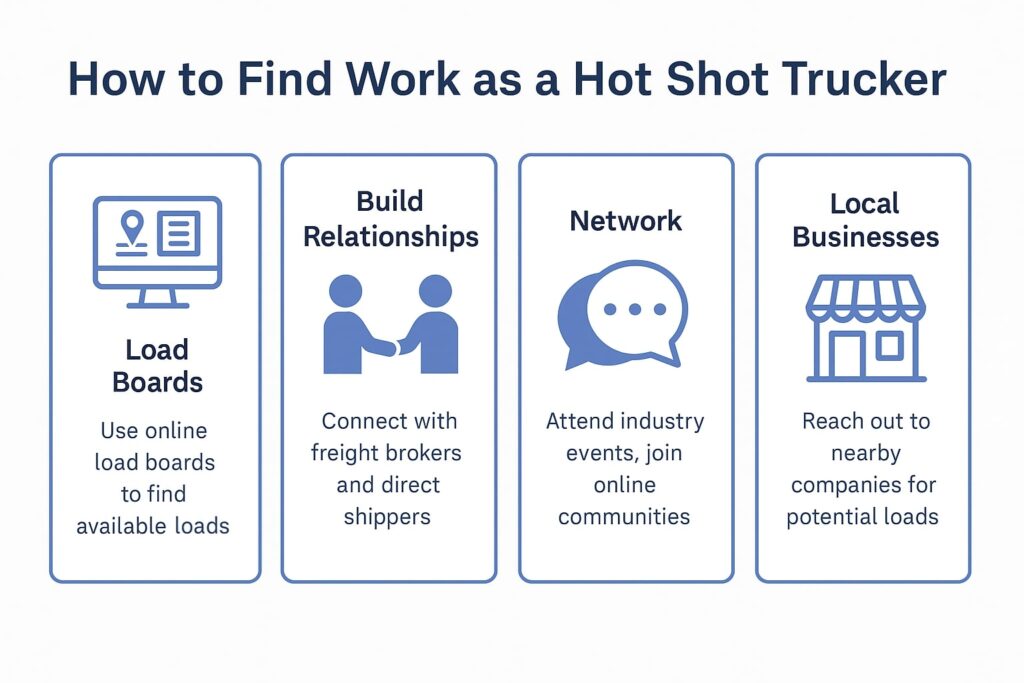
Networking is key in the hot shot world. Attend trucking industry events or trade shows in your region, join online communities (there are Facebook groups and forums for hotshot drivers), and don’t be shy about introducing yourself to freight brokers who specialize in your type of freight.
Local businesses can also be a source of loads – sometimes construction companies, farms, or manufacturers have urgent delivery needs and will call a hotshot directly rather than go through a large carrier.
Understanding the Market and Clients’ Needs
To really thrive, you’ll want to understand which industries and regions have strong demand for hot shot services.
Historically, oil and gas, construction, agriculture, and manufacturing have been big users of hotshot trucking. For example, an oilfield services company might need valves or tools delivered yesterday, or a construction crew might require a special part to keep a project going.
Seasonality can affect the market too. Agricultural equipment moves during planting or harvest seasons, construction materials in spring and summer, etc. Keep an eye on trends: if a hurricane or disaster hits a region, hotshots might be needed for relief supplies or generators. Learning the market also means knowing typical rates in your lanes so you can negotiate effectively. New drivers sometimes make the mistake of jumping on any load without calculating if it pays enough to cover costs. Always consider rate-per-mile and whether the load’s origin or destination will leave you stuck without a return load. Some regions are hotshot-friendly (Texas, for instance, often has a lot of oilfield-related hotshot work), while others might be tougher.
Clients’ expectations in this niche are high: they value speed and reliability above all. If a factory is waiting on you to avoid a shutdown, they expect you to pick up and deliver exactly when promised. Communicate proactively with clients and brokers – confirm pickup times, update them on any delays, and be courteous and professional. Understanding their needs also means knowing how to handle their freight: if a client has delicate machinery, you might need pads or special straps; if it’s high-value, they’ll want you to be extra vigilant.
Essentially, do some research on the kind of freight you haul and the industries you serve. The more you speak your clients’ language, the more they’ll trust you with repeat business.
Building Relationships and Networking
In trucking, and especially in hot shot trucking, your network is your net worth. Building strong relationships can lead to consistent work and better-paying loads.
Start by always delivering excellent service to your current clients – on-time deliveries, clear communication, and problem-solving go a long way to impress customers. A satisfied customer or broker is more likely to call you first the next time they have a load. One successful hot shot trucker advises, “Broker connections are everything.” To strengthen those connections, he suggests focusing on things like clear communication, reliability, and a clean safety record. In practice, this means if you accept a load, you follow through and do it safely and on schedule. If any issue arises, you inform the broker immediately and work out a solution. Over time, these brokers will come to trust you. As another veteran put it, “If brokers trust you, they’ll come to you first. … Load boards [often have] bottom of barrel loads.” In other words, when you’re someone’s go-to driver, you get the cream-of-the-crop freight before it ever hits the public load board. Networking isn’t limited to brokers either – connect with fellow drivers. Other hot shot drivers aren’t just competitors; they can be allies. They might refer overflow work to you or team up for multi-stop projects.
Joining an association like the Owner-Operator Independent Drivers Association (OOIDA) or local trucking groups can introduce you to mentors and peers. And don’t overlook the power of online networking: maintain a professional presence on platforms like LinkedIn or even a Facebook page for your business. Some hotshots create a simple website or Facebook business page showing their equipment and services – this can lend credibility when approaching new shippers.
Tip: focus on relationship-building as much as on driving. Make that follow-up call to thank a broker for a load, ask your customers for feedback, and always conduct yourself honestly and professionally. Your reputation is like gold in the hot shot community, and a good one will open many doors.
Financial Aspects, Pay Structures, and Rates in Hot Shot Trucking
Hot shot trucking income can vary widely, and it largely depends on how you charge and what loads you haul. The most common pay structure is per-mile rate – you might negotiate a certain dollar amount per mile for a load. Some loads pay flat rates for the trip (for example, $700 for a short run needed urgently, regardless of mileage). Hot shot rates are often higher per mile than regular freight because of the expedited service and smaller size. According to industry insights, hotshot loads are typically priced per mile and can command premium rates for urgent deliveries. However, those rates aren’t standardized; they fluctuate with supply and demand. You might secure a job at $3.50 per mile during peak demand, then only find loads at $1.75 per mile during a slower stretch. The rate landscape is constantly shifting, so successful drivers stay flexible and informed to protect their margins.
Also, keep in mind hot shots usually charge only for loaded miles. If you have to drive empty (deadhead) to your next pickup, that’s on you to cover, so successful drivers factor that in. Some hotshotters also earn money through fuel surcharges or extra fees (like detention time if they wait at a shipper too long), but as a new driver, focus on getting decent base rates first. One thing to know is that many hot shot drivers are essentially small business owners or independent contractors, not salaried. So there’s no fixed paycheck – your earnings come load by load. It’s crucial to negotiate wisely. Don’t be afraid to counter-offer on a rate if a broker’s offer barely covers your costs. As you gain experience, you’ll learn what a profitable rate is for you (taking into account fuel, wear-and-tear, etc.). In times when loads are plentiful, you can be choosier and hold out for better rates. In lean times, you might accept lower-paying freight just to keep moving. The pay structure also ties into how you get paid: some brokers pay upon delivery or within a week, while others might take 30 days or more. Many owner-operators use factoring companies to get paid faster (a factor advances you most of the invoice immediately for a small percentage fee). It’s an option to consider to maintain cash flow. The bottom line on pay: it’s performance-based and variable. You set your prices, but the market will dictate if they’re accepted. Stay informed on going rates and lanes to ensure you’re getting a fair deal.
Managing Expenses and Maximizing Profitability
Earning good revenue is only half the equation – managing your expenses is equally vital to succeed in hot shot trucking. As a new driver, it’s eye-opening how quickly costs add up. Major expenses include fuel, which will likely be your single biggest cost. and I’ve elaborated on how to improve fuel economy as a truck driver in another article.
Fuel economy for a truck pulling a trailer might be in the 8-12 mpg range, so plan accordingly and try to optimize routes to minimize empty miles. Using apps or fuel cards that give discounts can save a lot over the long haul.
Insurance premiums are another significant monthly expense – commercial auto liability and cargo insurance can run in the thousands of dollars annually, even for a one-truck operation. If you financed your truck or trailer, then you have loan payments to account for. One experienced hot shot trucker gave a stark breakdown for newcomers: between insurance, equipment payments, and other fixed costs, you could be looking at $2,200–$4,000 per month in overhead, before fuel and maintenance. It’s critical to know your break-even point – how much you must earn per mile or per week to cover all costs. Create a budget that includes not just obvious expenses like fuel, but also maintenance (oil changes, tires, repairs), permits, lodging on the road, meals, and taxes. Yes, taxes – as an independent contractor you’ll be responsible for self-employment taxes and income tax, so set aside a portion of your earnings for that, preferably in a separate savings account so you’re not caught off guard at tax time.
To maximize profitability, one strategy is to minimize deadhead miles. Try to book a return load for your trip so the trailer isn’t empty half the time. Sometimes this means working with freight brokers to find “backhauls” or using load boards to piece together multiple partial loads. Consolidating partial loads can boost your earnings per trip (e.g. carrying two smaller loads for two clients on the same route) – just be cautious to stay within weight limits and manage the extra coordination.
Another tip is route optimization: use GPS and planning tools to avoid out-of-route miles, heavy traffic, or tolls if possible, which saves both time and fuel. Operating efficiently in small ways adds up: driving at moderate speeds to conserve fuel, keeping tires properly inflated, and doing preventative maintenance can all protect your bottom line. Tracking every expense is important; consider using accounting software or a simple spreadsheet to log costs. This will help identify where you might cut costs (perhaps an expensive truck stop habit or too many motel stays). Also, continuously evaluate your rates – as fuel prices or insurance costs change, adjust the rates you seek for loads accordingly.
Remember, profitability isn’t just about high rates, it’s about the spread between your revenue and costs. A load paying $2.00/mi might be very profitable if your costs are $1.00/mi, whereas a $3.00/mi load could be a loss if it sends you to an area with no return loads and high deadhead. Smart hot shot operators learn to calculate their cost per mile and set minimum acceptable rates to ensure each job is worth it.
Tips for Financial Planning and Stability
The trucking business can be financially volatile, so planning ahead will save you a lot of stress. First, build an emergency fund. Set aside money for inevitable repairs – for example, a blown transmission or engine work on a diesel truck can cost thousands of dollars. Having a maintenance fund means you can get back on the road faster when something breaks. Next, consider forming a business entity (like an LLC) and keeping your business finances separate from personal finances. This not only helps at tax time with clearer records but also protects you legally. Pay yourself a salary or draw so that you don’t dip into business funds too freely.
Learn to anticipate dry spells: there may be weeks where freight is slow or you choose to pause for personal reasons. Plan your finances on an annual or quarterly basis, not week-to-week. If you have a few great weeks of profit, resist the urge to spend it all – put some away to cushion the lean weeks.
Insurance: make sure you have health insurance and consider disability insurance if trucking is your sole income; an injury or illness that sidelines you could be devastating without coverage. On the business side, shop around for the best rates on truck insurance or fuel cards each year – loyalty is nice, but saving money is nicer
Use technology to your advantage in financial planning. There are apps for expense tracking specifically for truckers that let you photograph receipts and track per diem, etc. Good records will help you claim tax deductions (fuel, maintenance, lodging, and even a portion of your meals can often be written off). Many new drivers underestimate their expenses; avoid that by diligently tracking everything from day one. You need to truly understand your operational expenses so you can set prices that keep you profitable. If you know your truck costs $1.20 per mile all-in to operate, you’ll know to aim for rates well above that. By being financially savvy and planning for the future, you’ll ride out the ups and downs of hot shot trucking with far less worry.
Essential Skills and Safety
Hot shot trucking may use smaller vehicles than a semi-truck, but it still requires professional driving skills. In some ways, pulling a 30+ foot gooseneck trailer with a pickup can be as challenging as a tractor-trailer.
One essential skill is trailering and backing. You should be comfortable maneuvering your truck and trailer in tight spaces, backing into docks or around corners safely. Practice makes perfect – new drivers often take time to master backing a long trailer with a pickup (the shorter wheelbase of the truck means it can jackknife quicker than a semi, so precise steering is needed).
Load securement is another critical skill: knowing how to properly strap or chain down freight so it doesn’t shift or fall off in transit. This involves understanding weight distribution on your trailer axles and using the right number of tie-downs as per DOT regulations (generally, secure each piece of cargo with a minimum of two straps/chains, more for heavy items).
Another skill of vital importance for any trucker is defensive driving. You have to compensate for the increased braking distance and handling differences when towing a heavy trailer. Keep extra following distance, be cautious on downgrades (use engine braking or lower gears to avoid overheating your truck’s brakes), and take turns slowly to prevent trailer sway or tipping. Hot shot setups can be prone to trailer sway if improperly loaded or at high speeds, so drivers learn to stay vigilant and avoid sudden maneuvers.
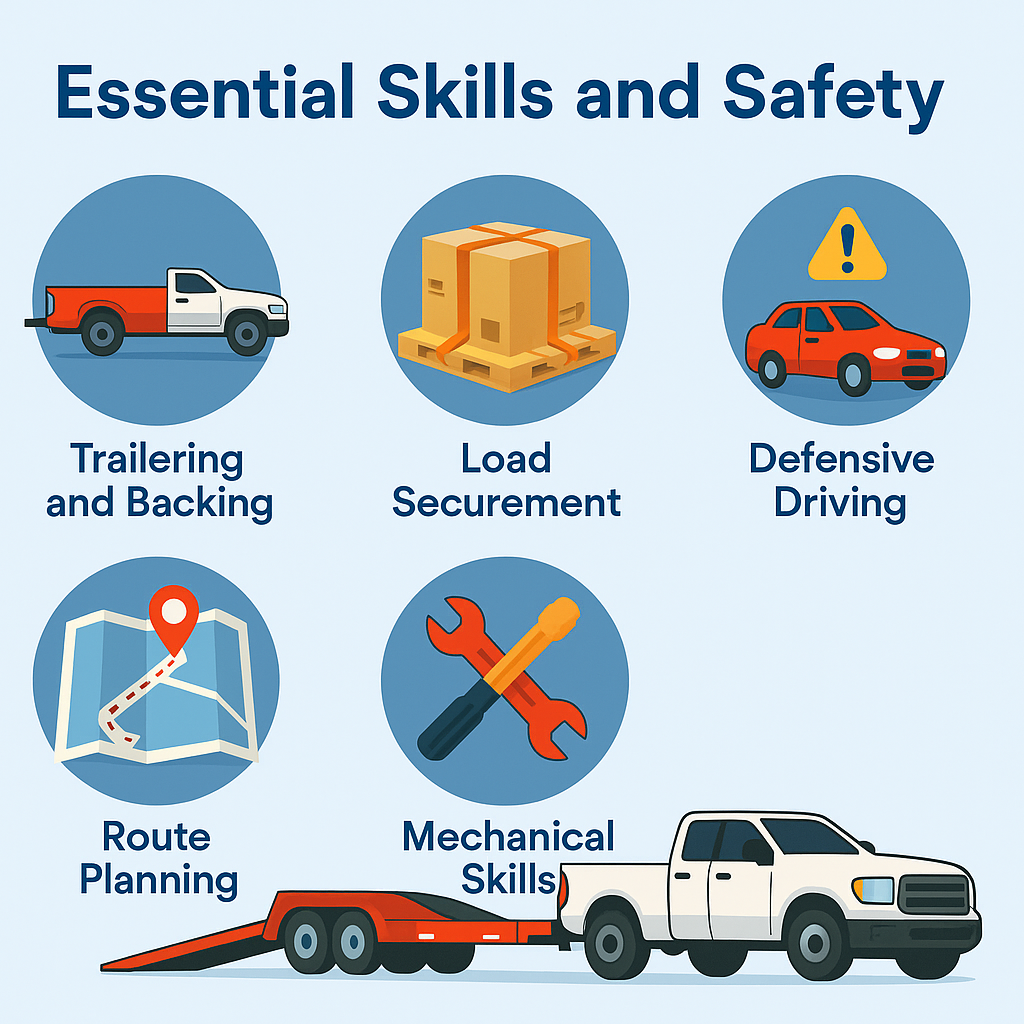
Another key skill is route planning. Because you’re often not as familiar with routes as a long-haul driver might be, you need to plan ahead: check for low bridges or roads where trucks are prohibited, factor in that you might not fit in every gas station or parking lot with your trailer. Utilizing GPS specifically for trucks (which accounts for your height/weight) can save headaches. Many hot shot drivers also carry paper road atlases as backup.
Time management as a skill comes into play: balancing your hours-of-service, scheduling pickups and deliveries, and estimating travel times accurately. You’ll get better at predicting how long it takes to load/unload and how traffic or terrain affects your drive.
On top of that, being handy with basic mechanical skills is a huge plus. While not strictly “driving” skill, knowing how to change a flat trailer tire, replace a fuse, or troubleshoot why your trailer lights went out on the road can keep you moving and safe. Speaking broadly, success in hot shot driving requires a blend of safe driving habits, technical know-how with your equipment, and good judgement.
If you feel your skills in any area are lacking, invest time in training – for example, practice backing in an empty lot or take a load securement course. These skills directly impact safety and efficiency on the road.
Safety Protocols and Best Practices
Safety in hot shot trucking is a priority – not only for protecting yourself and others on the road, but also for protecting the valuable cargo you carry and your business reputation.
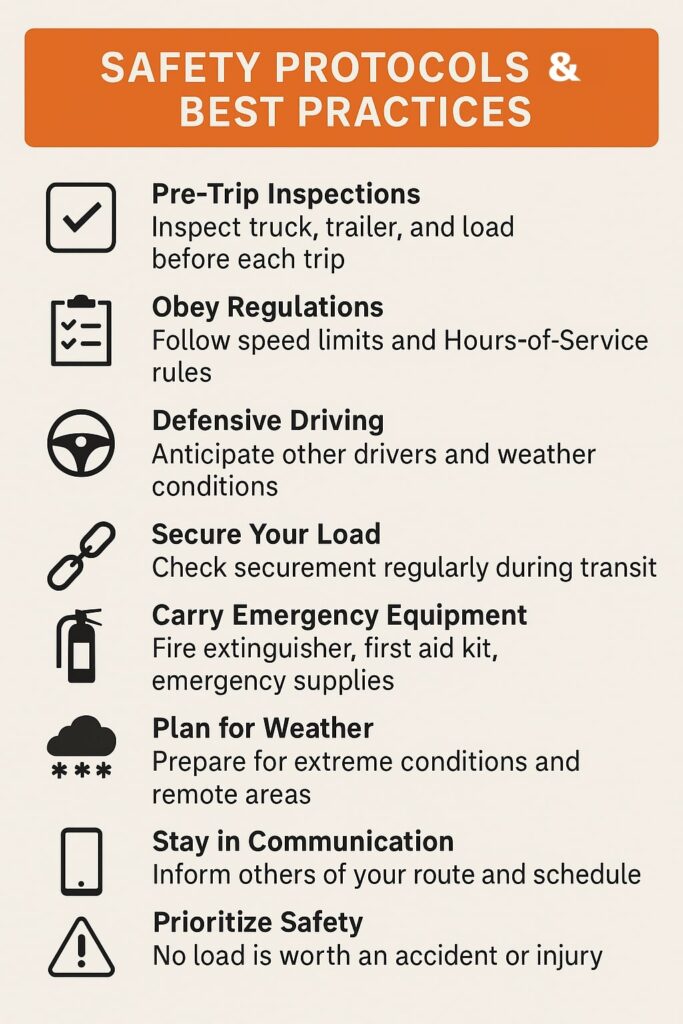
Pre-trip inspections should be part of your daily routine. Always do a thorough walk-around of your truck and trailer before hitting the road: check tire pressures (including trailer tires), lug nuts, lights, brakes, hitch connections, and that your load is secured properly. Catching a problem early (like a worn strap or low tire) can prevent accidents or roadside breakdowns.
While driving, follow the same regulations big truck drivers do. Obey speed limits (especially since towing at high speeds can be dangerous), and adhere to Hours-of-Service rules to avoid driving tired. It’s easy to say “just one more hour to finish this run,” but fatigued driving is a leading cause of accidents. Remember that hot shot drivers must comply with essentially the same safety laws – drug and alcohol testing, logbooks/ELDs, weight restrictions, etc – as any commercial driver.
Defensive driving is a best practice: anticipate what other drivers might do, keep your distance, and be extra careful in poor weather. Wind can be particularly hazardous for pickups with large trailers (an empty flatbed trailer can catch crosswinds), so slow down in high winds or storms. When it comes to load securement safety, check your straps or chains shortly after starting a trip (they can loosen up after the load settles) and periodically during transit, especially on long drives. Always carry a fire extinguisher and first aid kit in your truck. Know how to operate the fire extinguisher – whether it’s for a brake fire or an engine fire, acting fast can save your rig or cargo from total loss.
Weather planning is another aspect: if you’re going into mountain areas, carry tire chains in winter and know how to use them; if extreme heat, be mindful of your engine and tire pressure. Hot shot trucking sometimes involves more remote or off-road deliveries (like to a farm or oil site), so be cautious on unpaved roads – you don’t want to get stuck or damage your equipment far from help. A good practice is to keep emergency supplies in your truck: water, non-perishable food, warm clothes or blankets, in case you get stranded waiting for roadside assistance.
Communication is a safety tool too – inform someone (like a spouse or friend) of your route and schedule, especially if going into very remote areas, so someone knows where you are. Finally, maintain a safety-first mindset even if under pressure. No deadline or payout is worth an accident or injury. If you’re running behind, communicate with the customer instead of speeding. If you’re exhausted, take a break. Experienced truckers often say “safety is the best policy” – it keeps you alive and keeps your career alive.
Dealing with Emergencies and Unexpected Situations in Hot Shot Trucking
No matter how well you plan, eventually you’ll face an unexpected situation on the road – it could be a mechanical breakdown, a sudden road closure, or an accident. The key is to be prepared and stay calm.
Breakdowns: Suppose your truck or trailer has a mechanical issue (blowout, engine trouble, etc.). As a hot shot driver, you might not have the extensive support network a big company driver has, so plan ahead. Keep a list of emergency road service contacts, especially along your route.
Organizations like AAA (with RV coverage) or specialty commercial roadside services can be literal lifesavers. If you have a flat tire on your trailer and have the ability, you might change it yourself if it’s safe to do so – that’s why carrying a proper jack and spare tire is recommended. If you break down on a highway, get to the shoulder as far as possible, turn on flashers, deploy your reflective triangles to alert other drivers, and then assess the situation.
Emergencies on the road: In case of an accident or medical emergency, know the basics of what to do. If you’re involved in an accident, first check yourself and others for injuries and call 911 if needed. Being a trained first responder isn’t required, but having some first aid knowledge can be helpful until professionals arrive. Always report accidents to the authorities and your insurance as required. For less dire emergencies – say your GPS misroutes you or a key road is closed – having backup navigation knowledge (like reading a map) and using a CB radio or phone to get local traffic info can help reroute safely.
Weather emergencies: If you get caught in extreme weather (blizzard, hurricane, etc.), sometimes the best decision is to find a safe place to wait it out. Hot shot loads are urgent, but not at the expense of your life – communicate with the broker or client if you must pause due to weather.
Load issues: What if you discover mid-trip that a strap snapped or the load shifted dangerously? Safely pull over as soon as possible (at a rest area or truck stop ideally) and re-secure the load. It’s wise to periodically check your mirrors to spot any tarp flapping or load movement.
Health emergencies: If you fall ill while on a run (food poisoning or other sudden sickness), use your judgment. In minor cases, perhaps rest a bit and continue, but if serious, do not keep driving impaired. Call your dispatcher/client to inform them and seek medical help if needed. It’s better to deal with a late load than to have a medical crisis on the highway.
Another unexpected scenario: getting a ticket or put “out of service” at a DOT inspection. It happens – maybe an unaware mistake like an expired fire extinguisher or too many hours on your log. The best approach is to stay polite with officers, address the issue (pay the fine or fix the problem) as required, and learn from it so it doesn’t happen again. Keeping your paperwork and truck in order (remember that safety checklist) will minimize these headaches.
One more tip: consider investing in technology for emergencies. Dash cams can provide evidence if an accident occurs, and satellite communicators or personal locator beacons can call for help in areas with no cell signal. In summary, when the unexpected strikes, respond methodically: ensure immediate safety first, then communication (to authorities or clients as needed), then remediation. Every challenge can be overcome with the right preparation and mindset.
Advancements and Opportunities in Hot Shot Trucking
The trucking industry is rapidly changing with technology, and hot shot trucking is benefiting as well. One big advancement is in telematics and GPS technology. Modern GPS devices or smartphone apps allow hot shot drivers to get real-time navigation that accounts for road restrictions, traffic, and even weather, which helps in planning efficient routes. Telematics systems can also track your vehicle’s health – for example, some setups can alert you if the truck’s engine has a fault code or if the trailer tire pressure is low, giving you a chance to fix issues before they become costly problems.
Electronic Logging Devices (ELDs) are now common, even for hot shots running interstate. While at first ELDs might seem like a nuisance, many drivers find that using electronic logs simplifies compliance and helps them manage their hours more easily (no math errors or lost log sheets).
Load board apps and platforms have also advanced. You can now find and book loads straight from your phone. Apps might send you notifications when a load pops up in your area that fits your criteria, which can give you a jump on securing freight. There are even apps that allow you to bid on loads or see the rate upfront, increasing transparency.
Another area of tech is maintenance management: there are apps to track your maintenance schedule, remind you of oil changes, tire rotations, etc. Some hot shot operators use dash-mounted tablets or fleet management systems similar to larger fleets, which can include features like in-cab messaging, document scanning (to send paperwork immediately for quick payment), and performance monitoring (tracking fuel economy, idle time, etc. to help reduce costs).
Safety technology is making its way into pickup trucks too – newer trucks might have collision avoidance systems, lane departure warnings, backup cameras (great for hitching up trailers), and even adaptive cruise control. Such features can reduce the likelihood of accidents, which is crucial when you’re running your own business. If you haul specialized freight, you might invest in tech like temperature monitors (for perishable items) or GPS trackers that you give to clients so they can track high-value shipments in real time.
On the horizon, we see ongoing developments in things like electric trucks and alternative fuels. There is talk of electric pickup trucks eventually handling some hot shot tasks (especially for shorter regional runs), though currently the range while towing heavy loads is a limiting factor. Still, as battery technology improves, future hot shot drivers might utilize electric vehicles for certain applications, which could drastically cut fuel costs and maintenance (imagine not needing oil changes or worrying about diesel prices).
Automation and self-driving tech could also play a role, but it’s more likely to affect long-haul trucking first – for hot shots, the driver’s adaptability and personal touch remain key for now. Embracing these technological tools can give you a competitive edge: they can make your operation more efficient, safer, and even more professional in the eyes of clients. For instance, being able to provide instant updates or GPS tracking to a customer can set you apart from the competition. The future is definitely exciting for those willing to adapt to new tech in trucking.
Future Career Paths and Growth Opportunities
Starting out as a hot shot driver can be the first step in a broader trucking career. Many drivers enter hot shot trucking because of its lower startup cost and flexibility, but it doesn’t have to be the end goal unless you want it to be.
One potential path is expanding your hot shot operation – for example, adding another truck (maybe hire another driver) and growing into a small fleet. Some successful hot shot business owners build a reputation and then get direct contracts with companies, essentially acting like a niche carrier for certain clients. Over time, you might transition from driving full-time to also handling the dispatch and business side of a multi-truck operation.
Another path is moving into full-size trucking operations. After gaining experience and saving capital, you might decide to get a Class 8 truck and run a traditional trucking company or become an owner-operator with a big rig. The skills you learn in hot shot – finding loads, managing expenses, customer service – all translate to running with a semi, just on a larger scale. Alternatively, you might take your knowledge of the industry into allied careers: some hot shot truckers eventually become freight brokers or dispatchers themselves. With the contacts and insights you gain on the road, you could start brokering freight (even specializing in hot shot loads) or offering dispatch services to other small carriers. There is also the opportunity to specialize further: you may find a niche you really enjoy, like hauling tiny homes, or race cars, or special machinery, and build a brand around that specialty. Continuing education can open doors too.
For instance, obtaining additional endorsements or qualifications can allow you to haul more types of freight. If you get a hazardous materials (HazMat) endorsement, you could carry certain fuel or chemical loads; with a tanker endorsement, maybe you haul water or fuel in small tank trailers for oilfield work. Those often pay higher but require extra skills and safety training. If you started as a non-CDL hotshot, obtaining your CDL A down the line is a logical step to increase the weight and types of loads you can haul.
Technology and alternative logistics roles are another area – with your hands-on experience, you could consult or train other drivers, or work with companies developing trucking technology, providing the driver’s perspective. Given the growth of e-commerce and need for fast deliveries, hotshot-style services may remain in high demand, possibly leading to roles in operations management at logistics companies that offer expedited services. For those who prefer stability after years on the road, some transition to jobs like safety compliance officers, CDL instructors, or fleet maintenance planners.
The key point is: the experience you gain as a hot shot driver (problem-solving, time management, understanding freight) is valuable and can be leveraged into various opportunities. Keep an eye on industry trends, continue networking, and don’t hesitate to pursue additional training or certifications. The hot shot rig you’re driving today could very well be the foundation of your own transportation company or new career direction tomorrow.
Continuing Education and Skill Development
In any career, and trucking is no exception, continuous learning is important. The transportation industry has ever-changing regulations and best practices, so staying educated helps you remain compliant and competitive. One way to continue developing is through formal training courses or workshops. For example, you might attend a load securement workshop to learn advanced techniques for securing unusual freight.
Organizations like the National Association of Small Trucking Companies (NASTC) or local trucking associations sometimes offer seminars on topics like business management for owner-operators, dealing with new regulations, etc.
Online courses or webinars can also be very useful – topics might range from DOT compliance, improving fuel efficiency driving habits, to using technology like advanced GPS or fleet management software effectively.
Another aspect of continuing education is getting or renewing certifications. If you transport certain types of goods, getting certified in HAZMAT handling, CPR/first aid, or even TWIC (Transportation Worker Identification Credential) for port access can expand where and what you can haul. Since hot shot trucking straddles the line between trucking and small business, you might even consider courses in small business accounting, marketing, or entrepreneurship – these can help you run your operation more profitably. The FMCSA and DOT periodically update rules (for instance, changes in Hours-of-Service rules or ELD exemptions), so subscribing to industry newsletters or following trucking news sources will keep you informed of changes that could affect you. Many experienced drivers recommend joining forums or social media groups not just for networking but for learning – drivers often share tips or knowledge about new laws or equipment that you might not hear elsewhere. Also, never underestimate learning from peers: if you meet a veteran hot shot trucker who’s willing to mentor or just share stories, pay attention. Their “school of hard knocks” lessons are valuable education that you can’t find in books. If possible, attend trucking trade shows or expos (like the Mid-America Trucking Show, etc.) – these events sometimes have free educational sessions and let you see the latest products that might help your business (from trailer innovations to software).
Lastly, work on refining your soft skills: communication, negotiation, and customer service. These aren’t formal “education” in the usual sense, but improving how you communicate with brokers or how you present yourself to clients can significantly affect your success.
The most respected and successful drivers often are those who continually adapt and improve. Whether it’s mastering a new technology or simply learning from a mistake on a past load, every lesson you learn will boost your expertise and credibility in the industry.
Lessons Learned and Tips for Success
Through trial and error, experienced hot shot truckers have developed some golden rules. Here are a few common lessons learned:
- Plan your loads and routes carefully: Don’t accept a load going into a “dead zone” (an area with little freight) unless the rate justifies it or you have a plan for getting out. Always consider where that load drops you off and how you’ll get your next load.
- Maintain a cash buffer: Seasoned drivers have learned to prepare for the worst. A major truck repair or a slow month shouldn’t put you out of business. They suggest saving aggressively during good times. That also means living somewhat frugally on the road – small savings like using a portable fridge and cooking your own meals occasionally, or using reward programs for fuel, can help.
- Take care of yourself: A burnt-out driver makes mistakes. The pros emphasize getting enough sleep, eating as healthily as possible, and taking breaks. When you’re solo, your health is your most important asset. Also, maintain a good attitude – this job has its rough days (like sitting at a shipper for 6 hours, or dealing with a blown tire in the middle of nowhere), but a positive, problem-solving mindset will carry you through.
- Build a good reputation: This can’t be overstated. Word travels fast in the freight community. If you consistently do a good job, brokers will pass your name around. If you commit to a load, never abandon it or fall off the radar – that’s a surefire way to get blacklisted.
- Keep learning: The veterans never stop learning – whether it’s about new regulations or tips to secure a tricky piece of machinery. One driver said his turning point was when he started treating each day as a chance to improve, rather than thinking he knew everything.
Common Mistakes to Avoid
New hot shot drivers often stumble into similar pitfalls. Avoiding these can save you money and headaches:
- Underpricing your service: In eagerness to get business, newbies sometimes take loads at rock-bottom rates that barely (or don’t) cover costs. This can put you in a financial hole. Know your worth and don’t run for cheap, unsustainable rates. As the saying goes, sometimes “the loads you don’t take are as important as the ones you do.” It’s better to deadhead home empty than haul a cheap load that wears out your equipment for nothing.
- Ignoring regulations or paperwork: It can be tedious to manage licensing, logs, insurance proofs, etc., but neglecting these will bite you. Running without proper authority or going over weight limits without a CDL can lead to fines or being put out of service. Carry all required documents (driver’s license, med card, cab cards, etc.) and keep them organized.
- Poor planning of rest and fuel stops: Don’t push your fuel too low, especially in unfamiliar territory – not every small town has diesel or a place you can fit a truck and trailer. Plan fuel stops when you can, and don’t drive beyond your comfort just to reach a specific stop. Running out of fuel or hours in a bad spot is a rookie mistake.
- Neglecting truck and trailer maintenance: This is a business where your vehicle is your lifeline. Skipping maintenance to save a buck almost always leads to bigger expenses later (e.g., not fixing a small trailer brake issue could result in a major accident or costly roadside repair). Make a habit of weekly or monthly checklists for maintenance.
- Overloading or improper loading: Taking a load that exceeds your weight rating (even if you’re tempted by good pay) is illegal and unsafe. Similarly, not distributing weight properly on your trailer can cause accidents. Know your limits and stick to them. Many newbies also make the mistake of not scaling their load – invest in a portable scale or use truck stop scales to ensure you’re within legal axle and gross weights.
- Lack of professionalism: Even as an independent, you should treat this like a professional job. That means communicating well, showing up with appropriate safety gear (like steel-toe boots, safety vests if required at shippers), and treating people respectfully. A common newbie error is being too casual and not realizing every interaction (with a shipper, receiver, or broker) is essentially a job interview for future work.
Taking advice from those who have “been there, done that” will accelerate your learning curve significantly. The hot shot community is generally welcoming – many experienced drivers are happy to help newcomers who show seriousness and willingness to learn. So don’t hesitate to ask questions and heed the hard-earned wisdom they share.
